


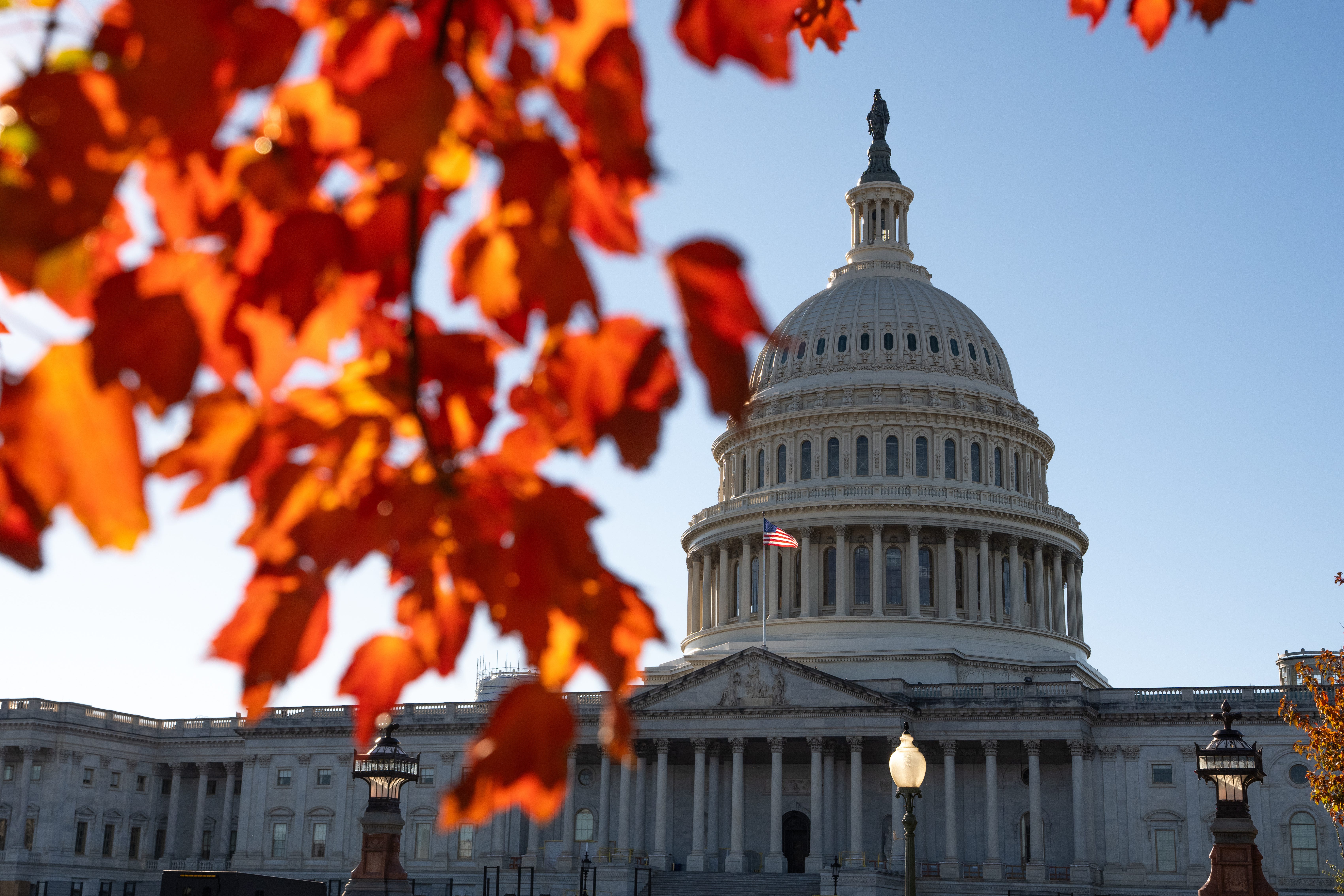
On Tuesday, the American people delivered the strongest possible rebuke of Donald Trump’s second term in what headlines called “historic,” “shellacking,” and a “rout.”
Voters swept a new generation of Democrats into power in the U.S. Senate and House of Representatives, governors’ offices, state attorney general posts, state supreme court chambers, and more. They rejected not just Trump, but his loyalists and lackeys, treating the races like he was on the ballot–as he demanded.
Before the ink was dry on the headlines, however, the apologists and cynics were already trying to spin the news. Axios declared that this extraordinary blue wave was not a mandate. Ridiculous! A New York Times columnist claimed this was exactly what Trump wanted. Absurd! Republicans like Nikki Haley tried to cast the election as a matter of “candidate quality” rather than a repudiation of Trump’s destructive policies or an endorsement of Democrats’ inspiring campaigns. Try harder! In other words, the spinners want you not to believe what your eyes are seeing.
As the great populist Jim Hightower once said: “The water won’t clear up until we get the hogs out of the creek.” In effect, the voters told Trump and his minions: “Quiet piggy!”
The midterm election results really are a stinging rebuke. Even Ron DeSantis called it “an extinction-level event” for Republicans.
What happened is an enormous grassroots feat, a massive determined effort by millions of people to impose a real check on Trump’s abuses of power and the havoc he has wreaked on American families and the world. More Americans turned out for this midterm election than any other since 1914, with the exception of the 2018 midterms–the only other time voters delivered a midway-point condemnation of Trump.
Almost every state trended bluer, many by double digits. Almost every demographic voted Democratic, except white men. Even a majority of baby boomers went blue. Republicans still won a majority of white voters without college degrees, but they lost about 14% of that contingent, too. This shift is seismic, a nationwide earthquake.
Let’s look at some of the results whose magnitude has not yet been fully appreciated.
I know part of this story because, two years ago this week, staggered by Trump’s win over Kamala Harris, I took a deep dive into whether there was any chance Democrats could get power in either house of Congress to impose checks on his coming abuses of power. In 2024, Republicans won a trifecta: the presidency, the Senate, and the House. But they really had a “superfecta,” or quadfecta, because they had also captured the U.S. Supreme Court, and John Roberts had delivered by helping to sweep Trump back into power through inventing immunity from criminal prosecution for him and his so-called “official acts.”
As a former Senate staffer, I looked at the Senate first. Every two years, about one-third of the U.S. Senate is up for re-election. As of January 2025, Democrats held only 45 seats, with two Independents (Bernie Sanders of Vermont and Angus King of Maine) caucusing with them.
Republicans held 53 seats, meaning they could lose three Republicans on any vote and still break a tie with the help of Vice President JD Vance. He had cast the deciding vote that installed the incompetent Pete Hegseth at DOD, despite the allegations of boozing and rape.
The prospect of Democrats retaking the Senate majority back then looked bleak.
For example, they would have to hold a Senate seat in a state Trump won in 2024: Jon Ossoff’s in Georgia, which was rated R+1 in the Cook Partisan Voting Index. They would also have to retain three seats where the Democrat was retiring, meaning no incumbent with a name recognition advantage: New Hampshire (D+2), Minnesota (D+3), and Michigan (R+0). They needed to hold all four of those seats just to maintain the status quo of being the minority party in the Senate.
To get to a bare majority, they would then need to pick up four additional seats. In reality, they needed five to build a working majority and avoid another Joe Manchin or Kyrsten Sinema style of policy betrayals (a role John Fetterman would soon appear poised to play).
The list of potential seat gains seemed almost entirely impossible, but, as we know now, that was not so:
It had been 30 years since Maine elected a Democrat to the Senate, but Troy Jackson just won. The race was rated D+4, hardly a sure thing, and Leonard Leo–who hand-picked Brett Kavanaugh for Trump’s SCOTUS nomination–fundraised for the incumbent Republican senator, Susan Collins, at his mansion in 2019 after she voted for Kavanaugh; Leo directed millions toward helping her this year.
In Texas, after Trump knocked out incumbent John Cornyn, schoolteacher James Talarico won big. The seat was rated R+6, and no Democrat had won a U.S. Senate race there since 1988. Voters also ousted Greg Abbott as governor in favor of Gina Hinojosa and Democrats swept almost every other statewide office. Ted Cruz is up for reelection in 2028 and will face an electorate that has shown its willingness to blunt Republican control in the wake of Trump’s ICE brutality and draconian state abortion restrictions. Plus, Texas turning blue really changes the Electoral College strategy for the 2028 presidential election and beyond.
In North Carolina (R+1) Trump pushed Thom Tillis out of running again after Tillis opposed his “Big, Beautiful Bill” due to the coming Medicaid cuts designed to enrich billionaires even further. The seat had been held for decades by the bigoted Jesse Helms, followed by other Republicans. Populist Democrat Roy Cooper won handily.
In Ohio (R+5), Sherrod Brown kicked John Husted’s now-infamous ass, ousting JD Vance’s replacement. Ohio also elected Dr. Amy Acton governor. Her opponent spent millions siding with a child molester–embraced by Trump and Vance, too. Democrats also retained and gained a seat on the Ohio Supreme Court.
Iowa (R+6) turned blue and elected a Democrat–Special Olympics gold medalist Josh Turek–to the Senate for the first time since Tom Harkin in 2008. Ds swept other state offices, too. Sen. Chuck Grassley, now 93, is still planning to run for re-election in 2028.
Dr. Annie Andrews flipped South Carolina (R+8) after Trump backed the late Sen. Lindsey Graham’s sister “Darline!” Before Trump loyalist Lindsey, the seat had been held for nearly 50 years by Dixiecrat Strom Thurmond, who once ran for president under the motto “Segregation Forever.” Andrews is the first woman elected to the U.S. Senate in South Carolina history.
Kansas (R+8) elected their first Democrat to the U.S. Senate in 93 years, shifting more than 21 points compared to the last race toward Democrat Adam Hamilton. Voters also threw out vote-suppressor Kris Kobach as Kansas Attorney General, replacing him with Democrat Chris Mann.
Alaska (R+6) is still too close to call, though Democrat Mary Peltola leads despite Trump’s efforts to stop the election from happening. In Mississippi (R+11), Democrat Scott Colom currently leads Cindy Hyde-Smith (who I call Confederate Barbie). If Colom prevails, he will be the first Black Senator elected there since the Reconstruction-era state legislature chose Hiram Revels in 1870 to serve a one-year term replacing Jefferson Davis, the president of the confederacy. Revels was the first Black U.S. senator in American history. Mississippi was on no politico’s bingo card for a win in 2026, but Colom and the voters did not give up and are still fighting to have all the votes counted.
The House of Representatives looked barely more promising as a potential firewall against Trump’s agenda and extremism. Of the 435 House seats, only about 30 were considered competitive and Democrats would have to keep half of them to just hold steady at 214. Then, they would need to pick-up at least four more to get to a majority.
So Trump began pressuring Republican-controlled states to redraw their congressional maps to cheat by helping him make it harder for Democrats to get the seats needed to counter him and conduct investigations.
He wasn’t acting alone. The Roberts Court jumped in to help him and fellow Republicans.
Earlier this spring, the Republican appointees on the nation’s highest court gutted the Voting Rights Act (VRA) and long-standing precedents to allow extreme partisan gerrymandering, even when doing so dilutes minority representation and bleaches out Black and Latino representation.
Republicans used mathematical precision to gerrymander more Democrats into fewer districts in order to maximize their own seat totals. In this cycle, Republican-controlled state legislatures or redistricting entities changed 12 maps to give Republicans an advantage, including Texas (+5 seats), Florida (+4), North Carolina (+1), and Ohio (+2).
The Roberts Court then ratified Texas’s steal (over objections by the lower court) and gave Republicans a shot at three more in Louisiana, Alabama, and Tennessee–for a total of 15–through its Louisiana v. Callais ruling, which neutered section 2 of the VRA. California countered with its own effort to flip 5 seats, while other states’ efforts–like those in Missouri, Virginia, Indiana, and Illinois–to change their maps were stalled.
If the scheme had prevailed and Republicans won the targets of the maps they rewrote while holding the rest, they would have controlled 234 seats in Congress. They could have easily weathered defections from more than a couple of members, like Thomas Massie, over major issues such as the Epstein Transparency Act, which mandates the disclosure of investigative files implicating Trump and others in sex crimes.
The American people resoundingly, resiliently, and even joyously rejected this scheme.
Right now, Democrats are on track to hit a near-super majority, with 260 members.
Republicans picked up only a few of the seats they re-mapped to steal. This wipeout is as significant as the New Deal wave, without the presidency… at least not yet.
Democrats will be able to pass legislation to help the American people, which Trump will probably veto and drag his party to further ruin. They will also have the power to investigate the financial and moral costs of the vast corruption and destruction his administration has unleashed. The Senate can also block his nominees to the judiciary and other posts and both houses can make the case for bold reforms of the Roberts Court and much, much more.
It’s a brand new day and, as Nina Simone so beautifully sang, I’m “Feeling Good.”
What I’m also singing and savoring:
Sharon Jones and the Dap Kings: “This Land Is Your Land.”
Eminem’s “Lose Yourself.”
And a trio of songs about surviving: “Survivor” by Destiny’s Child, I Will Survive by Gloria Gaynor, and Rio 2’s version. Although the rising fascism and incompetence of Trump and his enablers have tested our resolve, we must keep remembering that We the People are stronger than them.

Get the full receipts every Monday in The Cover-Up
Accountability starts with the record. COURIER’s new Contradictions Tracker compares testimony to the Epstein files, with every source linked. Follow along every Monday in The Cover-Up.
I can’t thank you enough, Lisa, for keeping us informed. We deserve to celebrate these victories but only concomitant with sure knowledge that much, much work lies ahead. … For some ways and whys the Roberts Court might be affected by this election …
https://stevevladeck.substack.com/p/261-the-midterms-and-the-courts-part?r=3codzl&utm_medium=ios
Thank you for your fight to end the abuses of this horrible Roberts court. I will believe it will go down in history as the worst court ever. Revered conservative justice Luttig says the immunity decision was far worse than Dred Scott, because it altered the actual structure of the constitution.
Did you know that black turnout in the south was significantly higher than it’s ever been? Whereas in the north it remained steady with previous elections so the white supremacism Roberts court had the opposite effect of what they intended with their grotesque Calais decision and flouting of the Purcell rule to ram this through before the election.