


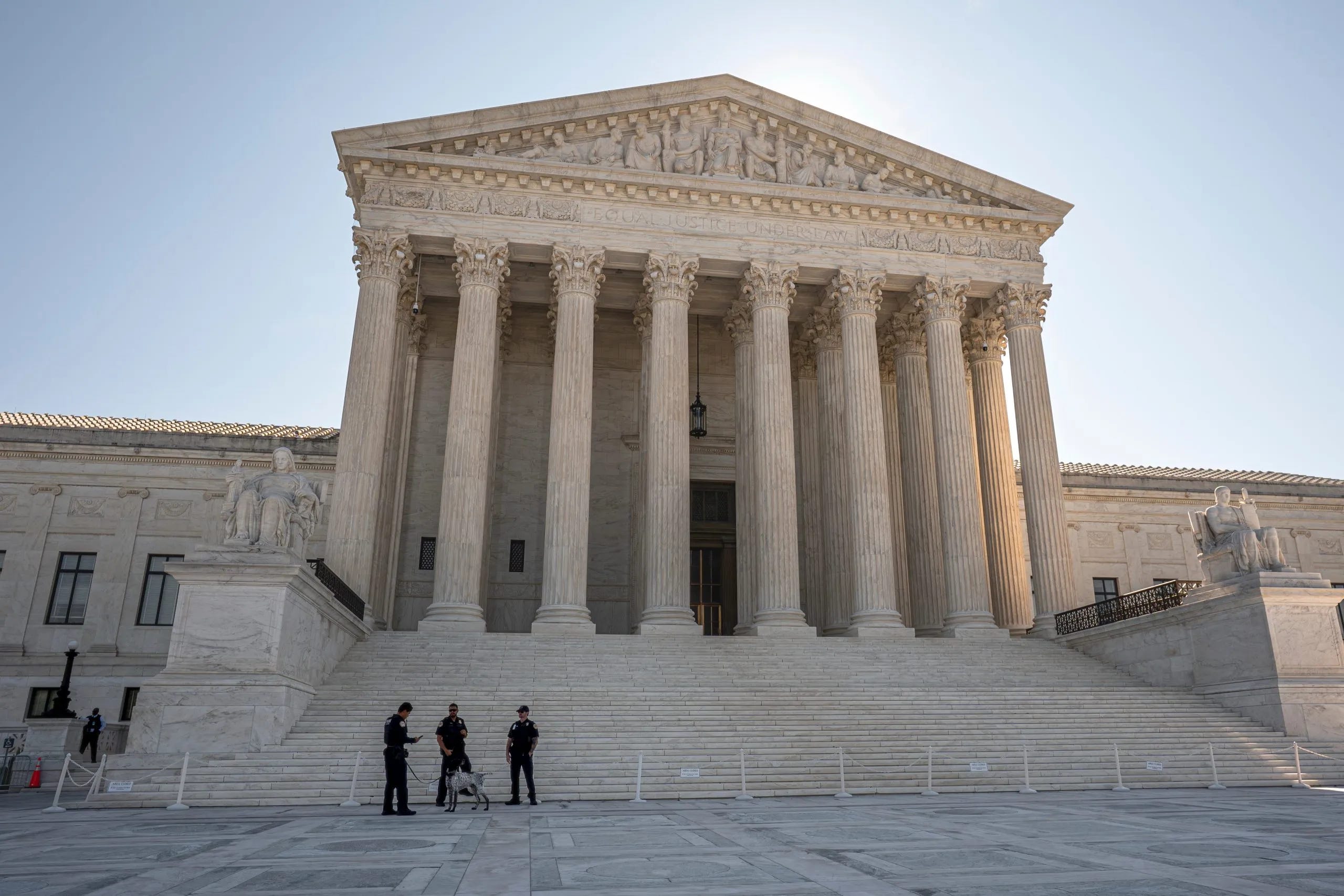
On Monday, November 30, the Roberts Court will hear oral arguments in a case right-wing judges are using to roll back the right to sue under Title IX for sex discrimination.
It’s 2026–how is this still on the agenda?
Last year, the U.S. Court of Appeals for the Eleventh Circuit issued a ruling that defied U.S. Supreme Court precedents that allow people to bring private suits under Title IX claiming discrimination based on their sex. The last major Supreme Court ruling on this issue came more than 20 years ago, in 2005, before John Roberts was confirmed to the Court. That legal precedent is called Jackson v. Birmingham Board of Education.
Justice Sandra Day O’Connor wrote the majority opinion in the case, a 5-4 ruling that was joined by appointees of both Democratic and Republican presidents: John Paul Stevens (Gerald Ford), David Souter (George H.W. Bush), Ruth Bader Ginsburg (Bill Clinton), and Stephen Breyer (Clinton). Clarence Thomas, appointed by Bush the senior, dissented and was joined by three Reagan appointees: Antonin Scalia, Anthony Kennedy, and Bill Rehnquist (who was initially appointed by Richard Nixon).
Before Jackson, only two circuits–the Fifth and Seventh–had issued opinions denying a private cause of action under Title IX. Now, the Eleventh Circuit has teed up an opportunity for the Roberts Court to reverse the Jackson ruling.
Nothing has actually changed, other than the personnel on the Supreme Court. As Justice O’Connor wrote in Planned Parenthood v. Casey, the case affirming Roe v. Wade:
A basic change in the law upon a ground no firmer than a change in our membership invites the popular misconception that this institution is little different from the two political branches of the Government. No misconception could do more lasting injury to the Court and to the system of law which it is our abiding mission to serve.
She was quoting Justice Potter Stewart to describe the profound importance of stare decisis–standing by things decided–in a democratic republic with a limited judicial role.
But it is that very principle that Roberts has repeatedly besieged as the court he helms tears down precedent after precedent on voting rights, abortion, and more. He has used his tenure to dismantle the leading legal precedents of the 20th century and has also targeted 21st century rulings issued shortly before he was appointed.
The Court without Roberts upheld the anti-corruption election measures of the Bipartisan Campaign Reform Act (BCRA/McCain-Feingold) in 2003. Just seven years later, the Roberts Court issued its corrupt ruling in the case called Citizens United.
It turns out that any legal precedent established before Trump kingmaker John was enthroned on the Court is fair game for reversal because, really, how could the nation’s highest court have gotten anything right before Roberts arrived? His arrogance is staggering.
The Supreme Court has long recognized the right of people who teach at schools receiving Title IX funds to sue for discrimination, holding that the statute includes an implied right to a private cause of action. As the majority noted in Jackson, the Court has “consistently interpreted Title IX’s private cause of action broadly to encompass diverse forms of intentional sex discrimination.”
Last year, however, the Eleventh Circuit took it upon itself to pre-reverse that precedent. Chief Judge Bill Pryor, Trump appointee Robert Luck, and Edward Carnes, the senior judge Luck clerked for (I’ll save the story on him for another day), ruled against the plaintiffs who had sued over sex discrimination under Title IX. The plaintiffs sought en banc review by the full circuit, but Pryor had the votes to deny it.
A majority of the judges on that circuit rejected the request; they were all Republican appointees, including six appointed during Trump’s first term and one appointed by George W. Bush: Bill Pryor. Five judges dissented, all appointed by Democratic presidents–three by Obama and two by Biden.
The Eleventh Circuit’s composition is another product of the court-capture machine Leonard Leo deployed with the help of Sen. Mitch McConnell, who helped keep a seat open there in spite of Obama having a nominee. That circuit is also the product of two Democratic appointees retiring during Trump’s presidency, while Republican appointees seemingly held out for a Republican president.
So, who exactly is Bill Pryor?
He is the Chief Judge of the Eleventh Circuit and was confirmed 53-45 in 2004 by a Republican-controlled Senate. Even Susan Collins voted against him.
Pryor was very controversial. As the Attorney General of Alabama, he co-founded the Republican Attorneys General Association (RAGA) in 1999. RAGA operated within the Republican State Leadership Committee, which became famous in 2010 for its “REDMAP” operation to capture state legislatures and redraw voting maps to give Republicans significant advantages in state and federal elections for years to come.
Before RAGA, state attorneys general worked relatively collaboratively through the bipartisan National Association of Attorneys General. Democratic and Republican AGs had even come together to sue the tobacco industry over the devastating health consequences and costs of smoking cigarettes.
RAGA was launched to raise money from industries like Big Tobacco and funnel it into AG election races, even though most attorneys general could not solicit corporate campaign contributions for themselves.
When I was Chief Counsel for Nominations on the Senate Judiciary Committee for Ranking Member Patrick Leahy, we were contacted by a whistleblower who had hundreds of documents detailing RAGA’s pay-to-play operation. When news of the leak broke, Republicans on the Committee were enraged and pushed for a criminal prosecution of the whistleblower, in addition to suppressing evidence she had provided.
But, they could not and cannot erase my memory of those documents.
I remember some of them very well because I was working with my team to try to block Pryor’s confirmation. RAGA had prepared call lists for Pryor to solicit money from numerous corporations that could be subject to state regulations. I recall specifically that his assigned calls included the big three tobacco companies: Philip Morris, RJR Reynolds, and Brown & Williamson. His list also included fossil fuel companies like Southern Company and BP and big telecom companies–some of which I have forgotten after so many years. I also distinctly remember the National Rifle Association appearing on his list, as it feared state AGs would pursue gun-industry liability litigation along the lines of the tobacco lawsuits that produced billion-dollar settlements.
My recollection is that the whistleblower also gave us a list of more than 1,000 corporate targets, with contact information, for fundraising calls by Pryor and other state AGs, including John Cornyn, who was a state AG before becoming a U.S. Senator. During the fight over Pryor’s nomination, Cornyn joined other Republicans in a letter assailing the whistleblower and Democrats, calling Pryor a “good and honest man.”
I also remember there were price sheets, like giving $25,000 would get the company special access to AGs at meetings at fancy resorts like Barton Creek in Texas. Since then, I have seen such price sheets through FOIAs my research groups have filed with RAGA AGs like Scott Pruitt and others, including one I published here.
It is also noteworthy that, as detailed by People for the American Way, when Pryor was a state AG speaking at a Federalist Society convention in 1999, it was he who really cemented the right-wing rallying cry of “No More Souters.”
He has not acted like the fair-minded Souter on the bench. Pryor routinely sides with right-wing groups on right-wing issues and goes even further than that. At another Federalist Society meeting a few years ago, he defended leader Leonard Leo against Sen. Sheldon Whitehouse’s investigation into Leo’s relationships with billionaires tied to Supreme Court justices. Pryor called allegations about Leo’s role a conspiracy theory, despite evidence showing Leo had arranged for Supreme Court justices, including Clarence Thomas, to meet with Charles Koch and other billionaires who fund the Federalist Society.
Leo’s court-capture machine is well documented. Kind of like a favor for a favor, it was Leo who led the “umbrella group” of special interest organizations that defended Pryor and other Bush nominees from Democratic opposition back when George W. Bush was president.
Then there is Robert Luck, who joined Pryor in castigating the five Democratic appointees to the Eleventh Circuit who dissented from the en banc request in the Title IX case. Here is how the Alliance for Justice described his ties to Leo:
Luck is a member of the Federalist Society, and his appointment to the Florida Supreme Court was “screened” by the group’s executive vice president Leonard Leo who flew down to Orlando and interviewed Luck for the position. Less than three weeks after Luck became a state Supreme Court justice, he was feted at the Florida chapter of the Federalist Society’s annual event at Disney World’s exclusive Yacht and Beach Club Resort.
Like Pryor, Luck has also sided with Republican causes since his 2019 confirmation.
This coming Monday, November 30, the Roberts Court will consider the appeal from the Eleventh Circuit’s ruling in that Title IX case. The Trump administration has weighed in against access to the courts for private discrimination claims through that statute. Its brief was submitted by Trump appointees who served as Trump’s personal attorneys– John Sauer and Harmeet Dhillon–and other Justice Department lawyers.
We will soon see what the Roberts Court does to dismantle Title IX and precedent, too.
What I’m reading:
The amicus brief of the National Women’s Law Center and others, which argues that Title IX’s legislative and judicial history supports overturning Pryor, Luck, and Carnes–not closing the courthouse door to people suing for discrimination based on sex under that landmark anti-discrimination law.
Cannon v. University of Chicago, the Supreme Court’s original ruling in 1979 allowing a private suit for discrimination under Title IX, finding that trailblazer Geraldine Cannon had a right to sue for being denied admission to medical school.
The 14th Amendment to the U.S. Constitution that commands “equal protection” of the law.

Get the full receipts every Monday in The Cover-Up
Accountability starts with the record. COURIER’s new Contradictions Tracker compares testimony to the Epstein files, with every source linked. Follow along every Monday in The Cover-Up.
I'm deeply saddened that I didn't particularly follow the ins and outs, or really understand the Supreme Court with any kind of thoroughness before I read your work. And, what your work reveals grieves me more, but I continue to be very grateful for the light you're shining, and for the stand you are taking against cruelty, corruption and erosion of the rule of law by Roberts, Leo and company.
The corrupt right wing of the Supreme Court needs a complete clean-out. It needs to be fumigated too, while we're at it. Starting with Roberts.