


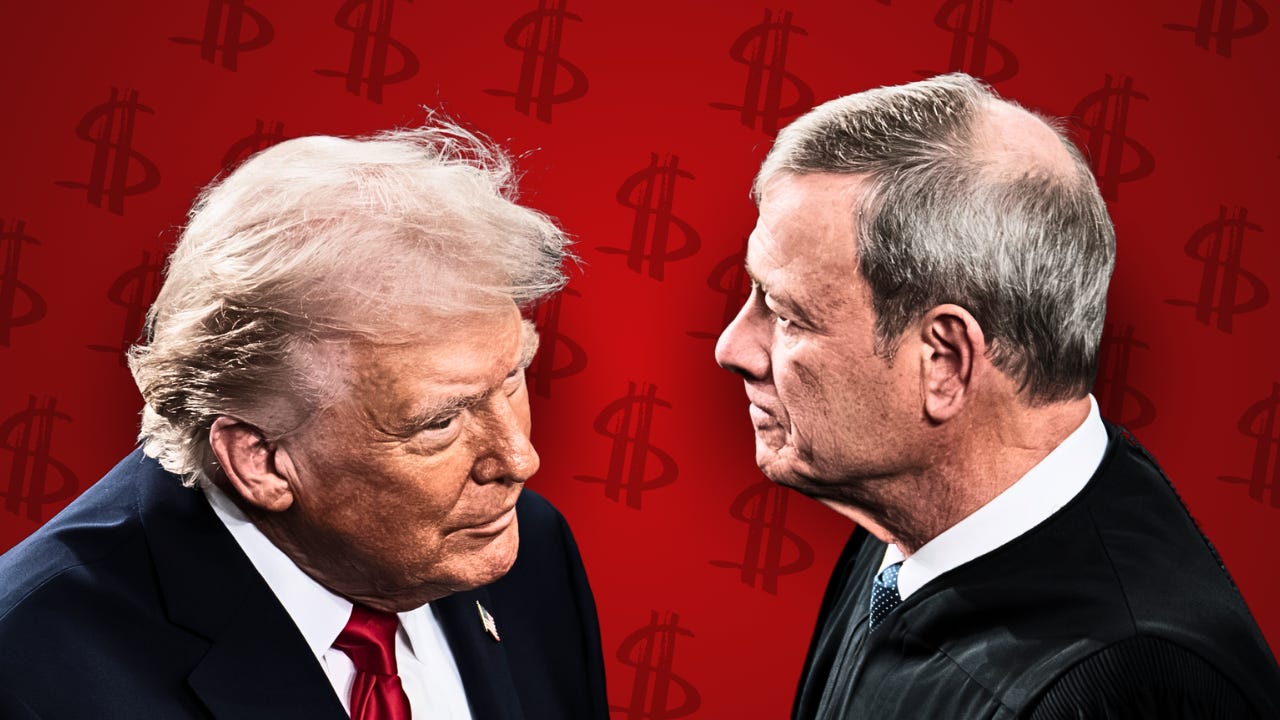
The first Monday in October marks the official opening of the U.S. Supreme Court’s 2026 term, but in many ways, the Roberts Court never really left.
Sure, Chief Justice John Roberts took some time by the shore of the private island off the coast of Maine where he owns not one but two summer homes, and the other justices took their own posh vacations, too. But Roberts and his fellow Republican appointees were also busy responding to Donald Trump’s repeated cries of “emergency” whenever impartial lower court judges temporarily blocked his destructive desires.
I suppose we shouldn’t be shocked that, like millions of Americans, Roberts worked from home. Unlike most people, however, his home was his second and third residences, side by side on the water in Penobscot Bay. After all, Roberts is the richest justice on the nation’s highest court, with a fortune that has grown in part through his wife’s work placing elite lawyers at prestigious law firms, many of which have business before the Court. In August, a couple dozen peaceful protesters—and one sea-faring dog—kayaked in front of Roberts’s waterfront places to hold a “By Land and By Sea” vigil. They carried signs saying “Roberts Benched the Constitution” and “The Roberts Court: A Rubber-Stamp for Fascism.”
Those signs were printed before the Court’s latest decree, which overturned a lower court order temporarily blocking the Trump administration’s efforts to deport people to third countries they have never been to, without giving them a meaningful opportunity to contest being sent somewhere they might be tortured or killed. That policy sure sounds like something a fascist would do, and the Roberts Court’s action sure looks like a rubber stamp.
Lawyers for the immigrants being targeted by Trump told the Court that the administration’s claims of harm—which amount to whining about the inconvenience of waiting and the alleged expense of canceled flights—“ignore the significant harm resulting from deporting thousands of longtime U.S. residents, many with no criminal history, to third countries without regard to the persecution or torture they face there.”
The cowards in the Republican majority of the Roberts Court refused to attach individual names to the opinion that at least one of them or their clerks actually wrote. Instead, the Court issued the decree “per curiam,” which traditionally means unanimous, even though three justices—Sotomayor, Jackson, and Kagan—dissented.
Again, the Republican-appointed justices intervened to protect a Republican MAGA policy, allowing a potentially deadly plan to proceed while the Court waits to hear oral arguments in December. A final ruling could come as far as nine months from now.
Meanwhile, thanks to the Court’s aggressive intervention in his favor, Trump can continue sending an untold number of people to 29 other countries, including:
South Sudan, where the U.S. State Department has issued a Level 4 “Do Not Travel” warning due to the deadly Ebola outbreak, stating that “Americans should not travel [there] for any reason,”
Rwanda, which has a Level 3 “Reconsider Travel” warning (and Level 4 for parts of the country due to a regional genocidal civil war), and
Eswatini, which has a Level 2 caution from the State Department and is an absolute monarchy where the king has imprisoned journalists and pro-democracy activists.
The ruling that John Roberts, Sam Alito, Clarence Thomas, Brett Kavanaugh, Neil Gorsuch, and Amy Coney Barrett signed off on without signing shocks the conscience.
And that’s not all.
As the award-winning outlet ProPublica reported, the Roberts Court has now passed a milestone no other Supreme Court has: “For the first time, it decided more cases by secret ballot, and with few signed opinions, than it did for cases argued in open court.” In other words, it has been using the shadowy shadow docket to remake our laws and implicitly overturn legal precedents that lower court judges have faithfully followed, displacing the detailed factual findings of trial court judges. Almost all of this has been in aid of Trump, the man John Roberts concocted criminal immunity for after Trump unleashed the worst attack on the U.S. Capitol since the War of 1812 in an effort to subvert the 2020 election.
The dozens of rulings for Trump since Roberts administered the presidential oath of office in 2025—when Trump claimed he would protect and defend the Constitution—have further aggrandized his power. He has since run rampant, decimating federal agencies, diverting congressional budget allocations for public health, laying siege to American cities, selling out our resources, and dictating so much more.
Yet now we are supposed to believe that the Roberts Court took up the climate case because it has fair-minded intentions? As with the Trump cases, the Court did not have to accept the appeal by Suncor and Exxon challenging the suit against them in Colorado state court.
The Roberts Court chose to take up that case because at least four justices wanted to—and presumably thought they had five votes—to help the oil companies escape potential liability under state law. I am glad that Sam Alito recused himself from the case. In my view, the federal recusal statute required him to do so because he is personally invested in an array of fossil fuel stocks that would benefit from a ruling for Suncor and Exxon.
But I worry that his belated recusal means that the other justices in his faction don’t need his vote to prevail and so him remaining on the case would muddy the waters and taint the coverage of the eventual ruling.
In research I spearheaded this summer, we documented that Alito previously made up to nearly $250,000 from his Exxon holdings alone (enough to help buy his waterfront summer home in New Jersey). We also found that his fossil fuel holdings have increased his wealth by as much as $2.9 million since his appointment to the Court.
Come Monday, we are supposed to believe that the oral argument—where Trump’s gravelly mouthpiece, John Sauer, will argue on the side of the oil companies—is not a kind of theatre and that the justices’ minds are not already made up. Alito’s belated recusal did nothing to prevent him from discussing the case with the other justices for the past year. Before now, he could discuss any or all of the briefs, including numerous amicus briefs from groups funded by fossil fuel billionaire Charles Koch and billionaire trustee Leonard Leo. Leo has long cultivated Big Oil donors to the Federalist Society: Koch and his company, Gold Circle donor Chevron, and dozens of lawyers and law firms that represent the oil majors and related industries.
And after all of this—including the reality that no federal law preempts states from hearing environmental tort cases against corporations—we are supposed to accept that five judges on the Supreme Court, who are totally unaccountable to us, get to dictate our ability to hold oil companies accountable. Exxon literally knew that burning fossil fuels was altering our atmosphere and harming the viability of life on our planet.
I, for one, refuse to accept that fate.
That’s the fate John Roberts presumes he can dictate. Shortly after he was confirmed, he told C-Span that if the American people don’t like what his court does, “it’s just too bad.”
It’s more than too bad. It’s a disaster for our country and our world. And I am determined to do everything within the law and within my power to rebuke and reform the Roberts Court, and repair the grave damage it has done to our democracy and our future.
We can chart a new path and we must. The first step is to be clear-eyed about what the Roberts Court is and what it is not. It is not a fair court. It is acting as an arm—and indeed an armament—of the powerful, against the public interest of the American people, almost every time it rules.
What I’m Reading or Rereading:
I am reading through all of the amicus briefs filed in the Suncor case and look forward to letting you know what I uncover about the financial ties of the array of front and dark money groups echoing Big Oil’s claims.
Since I have been recovering from emergency surgery, I have also been reading every day for enjoyment and for a little daily guidance and encouragement. My latest find is Literary Letters for Every Day of the Year.
And, Article III of the U.S. Constitution—specifically the exceptions clause, which allows Congress to set the types of cases the Supreme Court can hear beyond the ones it must hear, such as disputes between states over their borders.

What’s really happening at the Supreme Court?
Join COURIER and Americans United on October 20 for Weaponizing Faith: Christian Nationalism at the Supreme Court. Featuring Rachel Laser, Stasha M. Rhodes, Michael Podhorzer, and moderator Lisa Graves, this panel uncovers how political allies are reshaping our legal system and what we must do to reclaim it.
Attend in person at The Milton Theatre in D.C. or watch the live stream online. RSVP today!

Get the full receipts every Monday in The Cover-Up
Accountability starts with the record. COURIER’s new Contradictions Tracker compares testimony to the Epstein files, with every source linked. Follow along every Monday in The Cover-Up.
Thank you Lisa . Keep fighting for us.💪
Wow. The conservative justices are financially benefiting from the same system that's enriching so many politicians. No wonder they choose to shield Trump.
<<Trump’s gravelly mouthpiece, John Sauer>>
This made me chuckle. 😄