


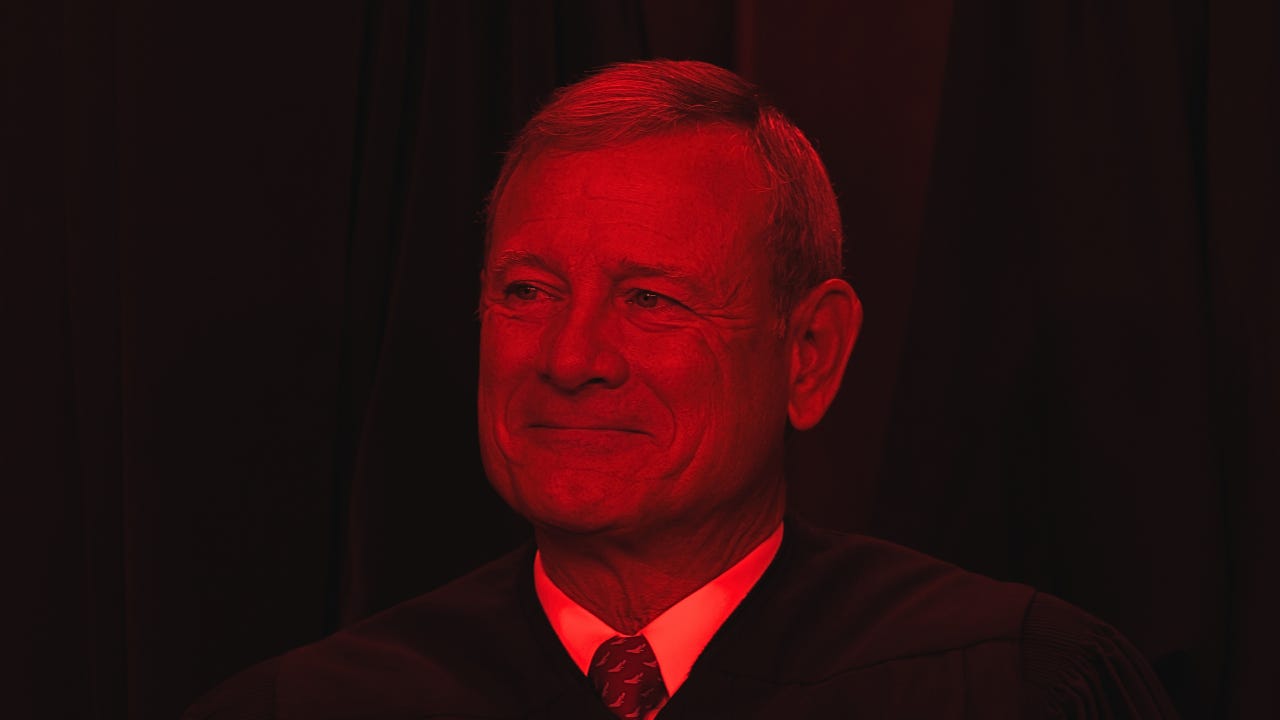
This month, the Roberts Court is expected to issue a ruling to officially destroy the independence of the Federal Trade Commission (FTC) and overturn nearly a century of legal precedent. This is a choice–an illegitimate one–not a necessity or requirement of the law, no matter what John Roberts and his fellow Republican appointees on the Supreme Court may claim in Trump v. Slaughter. Their edict will be dressed up in the language of “separation of powers,” but that is merely a costume for this extraordinary power grab.
The Roberts Court has already allowed Donald Trump to destroy the independence of the FTC as a practical matter. Last March, Trump illegally fired Rebecca Slaughter and Alvaro Bedoya, the two Democratic appointees to the agency who had been confirmed by the Senate. This action was not just theoretically illegal: it violated the plain language of the statute governing the FTC, created in 1914. It also violated a long-standing Supreme Court precedent affirming the constitutionality of that statute–a 1931 case called Humphrey’s Executor–which rejected FDR’s efforts to fire an FTC commissioner, appointed by his predecessor, Herbert Hoover, without cause or any misconduct.
The lower federal courts responded appropriately when Slaughter sued, reinstating her. It did so while continuing the litigation to consider Trump’s claim that under the “unitary executive theory” all executive power “vests” in him and so he can fire anyone in the executive branch at any time for any reason or no reason at all.
Despite the clear illegality of Trump’s action, the Roberts Court intervened through its “shadow docket,” without oral argument, and overturned the temporary restraining order that had preserved the status quo–namely that Slaughter was a duly appointed commissioner who could not be fired without cause–while Trump’s assertion of unilateral power was litigated. Instead, in one of dozens of such shadowy edicts, the Roberts Court allowed Trump to effectively win before the case had been decided, turning the standard temporary restraining order process on its head and keeping Slaughter off of the FTC.
That’s because one of the things the Roberts Court is doing is pre-reversing the law to aid Trump and its own illegitimate agenda until it can get around to making it official.
By statute, the FTC is supposed to have five commissioners, three from one party and two from the other, with the president naming the chair. But that was not enough power for Trump. He wanted Democratic appointees kept out of the room where it happens, excluded from decisionmaking–even in dissent–on mergers that might reduce competition or violate antitrust laws. Such mergers could benefit Trump’s backers or serve his transactional politics, while harming consumers by driving prices higher.
Since Slaughter’s firing, the FTC has terminated more than three dozen merger enforcement investigations. That includes examinations involving companies run by major Trump donors, such as Google. Last fall, the FTC terminated its examination of Google’s planned $32 billion acquisition of Wiz, a cloud/AI start-up, the company’s largest acquisition ever. Sundar Pichai, the CEO of Alphabet, Google’s holding company, stood behind Trump at his inauguration last year, and Google/Alphabet gave $1 million to Trump’s inauguration committee. Google is also one of the companies underwriting Trump’s $400 million ballroom pay-to-play boondoggle. Would that merger have gone through if President Joe Biden’s appointee, Lina Khan–a vocal critic of Google’s and Amazon’s mega market power–were still chairing the FTC (if Kamala Harris had won)? We will never know. To be fair, the FTC is appealing its case against Meta–perhaps Mark Zuckerberg has not ponied up enough for Trump.
Since last spring, the FTC has had only two commissioners, both Republicans. Trump named Andrew Ferguson, a former Mitch McConnell aide and Clarence Thomas clerk, to replace Khan as chair. He also secured Senate confirmation for Mark Meador after firing the remaining Democrats. Meador previously staffed Trump ally Sen. Mike Lee before joining the Heritage Foundation, the group behind the 900+ page “Mandate for Leadership” (better known as “Project 2025”)–the destructive blueprint Trump has been implementing, despite his deceptive claims during the campaign that he had nothing to do with it.
Project 2025 devotes an entire chapter to limiting the power of the FTC, even questioning if the agency should continue enforcing antitrust laws that preserve competition, a core mission of the agency to help protect consumers from price gouging and abuse by monopolies. The blueprint expressly urged the next president (Trump) to violate Humphrey’s Executor and tee up a case for the Roberts Court to overturn that legal precedent. It also attacks the FTC’s statutory bar on a president removing commissioners without cause, arguing it supposedly violates the “vesting” clause of the Constitution.
This may seem arcane, but it is all about power and it’s important to understand how we got here. That vesting clause argument traces back to Robert Bork, who argued in 1974 that Congress could not create an independent counsel to investigate presidential crimes–and be protected from firing–because doing so would violate the executive powers vested in the president under Article II. It was Bork who, in the infamous Saturday Night Massacre, fired Archibald Cox, the federal prosecutor investigating the Watergate crimes, after the Attorney General and his Deputy resigned rather than carry out Richard Nixon’s orders. The Reagan administration embraced Bork by naming him to the D.C. Circuit and then trying to install him on the Supreme Court.
The Reagan administration also took up Bork’s mantle in asserting that Congress could not constrain presidents with independent counsels or agencies, as then-Attorney General Ed Meese asserted in a radical speech to the American Bar Association in 1985.
Legal scholar Deborah Perlstein has compellingly described their conception of the so-called “unitary executive theory” thus:
So singular was the President’s power, the theory went, that it called into constitutional question the authority of Congress or the courts to regulate Executive Branch personnel or processes in any way that interfered with the President’s ability to make policy, appoint or fire Executive Branch officials, or even interpret the scope of his own constitutional power.
That’s precisely where we are today, with Trump in power and Roberts at the helm of the highest court in the land. This theory has animated the subservience of the Justice Department under Acting Attorney General Todd Blanche, and meanwhile the Roberts Court is turning it from a theory into a mandate in destructive ways that will outlive Trump.
As Leonard Leo—who orchestrated the packing of the Supreme Court with backing from right-wing billionaires—extolled after Brett Kavanaugh’s confirmation secured a majority of five former and devoted Republican administration officials on the high court:
I think we stand at the threshold of an exciting moment in our republic. The revival of our structural constitution by the US Supreme Court ... And this is really, I think in recent memory, a newfound embrace of limited constitutional government in our country. I don’t think this has really happened since probably before the New Deal, which means no one in this room has probably experienced the kind of transformation that I think we are beginning to see.
That is the transformation–or rather, the regression–we are witnessing.
Roberts got partway there in his opinion in Seila Law v. Consumer Financial Protection Bureau in 2020, and he didn’t need Amy Coney Barrett to do it. In that case, he began the destruction of independent and quasi-independent agencies by declaring that Trump could remove the head of the CFPB at will, despite Congress requiring cause for removal when it created the Bureau after Wall Street crashed during the George W. Bush administration.
And who runs the CFPB right now? It’s no longer independent: the unconfirmed acting head is Russell Vought, another Project 2025 operative who has been wreaking havoc on the federal agencies that protect our interests, after aiding Elon Musk’s dodgy firings as the head of the White House Office of Management and Budget.
Notably, in Seila Law, Roberts distinguished the CFPB from the FTC, arguing that the latter was structured to be quasi-legislative. Now here we are, five short years later, with Roberts ready and eager to kill the FTC’s independence and flagrantly ignore his own recent reasoning.
This is part of Roberts’ playbook on abortion and other issues where even the Court’s own recent precedent or assurances really aren’t worth the paper they are written on. Just look at his methodical dismantling of the Voting Rights Act in phases, starting with Shelby and continuing through Callais, where he eviscerates one protection while insisting others remain–only to return later and dismantle those as well.
This time, Roberts is poised to ratify another gift of unprecedented power to Trump by saying that firing FTC commissioners is no longer illegal, even if he stops short of allowing Trump to fire Federal Reserve governors. That, too, would fit Roberts’ track record of siding with Wall Street when it is in (rare) conflict with Trump or the Republican Party, not for the sake of consumers–as the tariff ruling earlier this year demonstrated–but to preserve a different set of elite interests.
What’s clear is that the Roberts Court continues to wield power not like a fair and impartial court, but like a group of chieftains in a war to remake our legal landscape. These arrogant operatives in black robes are not checking their biases at the courthouse door; they have moved their prejudices and partisanship in like luggage and a wardrobe. We are going to have to reform this Court to restore real checks and balances, including a president faithfully executing our laws rather than being given legal license to bend and break them.
What I’m Reading:
Deborah Perlstein’s “The Democracy Effects of Legal Polarization: Movement Lawyering at the Dawn of the Unitary Executive”
She details the machinations inside the Reagan administration that spawned the “unitary executive theory” and some of the effects we are living through today.
Paul Blumenthal’s “The Supreme Court Is Illegitimate,” which dismantles the Roberts Court’s partisan intervention in the 2026 midterms and its destruction of the landmark Voting Rights Act.
And, Article II of the U.S. Constitution, which has no mention of the so-called unitary executive theory and instead commands the president to faithfully execute the laws passed by Congress.
Good reporting, thank you! Vought goes undetected. He is really rotten.
Thank you for speaking out on an evergreen and even over-arching issue. This unitary executive theory smacks of crowning the president AS KING. The legislatively constructed agencies meant to be independent should be defended -- uniformly -- as independent. The process of filling Fed seats has traditionally focused on expertise (few Fox News members) and staggered in a way that every president (criminal or beyond the law or more normal) has an impact but NOT control. The history of world monetary authority is littered with the examples of why there should be a separation of politics and monetary policy.
For all of the "independent" agencies, there is, nevertheless, influence from the President either through nominations, the designated political split or even just the not-so-subtle pressure to be or not to be "active" on all of them. The FTC Federal Trade Commission was constructed to enforce existing legislation on antitrust laws, but not to protect a president's donors. With firing at will, it is not the same FTC. The DOJ has many duties it isn't doing already, but it should always have competent staff who examine mergers or acquisition. I don't know the legislative underpinnings, and this probably behaves more politically than some of the others simply because it is in the DOJ. Should it? Has the nature of competition changed in a fundamental way that makes such oversight unnecessary?. What happens with regulation of financial markets through the Securities and Exchange Commission (SEC) will never be unimportant, but it should keep up with financial "innovations" like watching crypto markets. Are they? The financial crisis was a wake up call: some financial institutions chose their watchdogs which damaged the independence. Trump was clear about wanting to be rid of the Consumer Financial Protection Bureau (CFPB), but this, again, was created through legislation. There are so very few protections of consumers left in our world. The financial industry is not as easily understood as the bruises on a banana or bad car breaks. Given innovation in financial markets, it is no less important than it was when started. Remember the financial world bringing down the economy? It was not so long ago.
If a president has the power of both Houses and Senate, those "independent" agencies started by legislation should be IMMUNE from destruction without NEW legislation, and never by the arbitrary lines drawn by the Supreme Court. Was the original legislation unconstitutional and this is the first time that has been noticed? Were there flaws never before identified in the original legislation? When can the Supreme Court throw out a law? If so, there must be a cogent argument.
The Unitary Executive Theory does not appear in the Constitution as far as most of us can see, so where was this dreamed up? The voting rights act was recently gutted by a simple declaration that racism is dead. WHO believes that.? Supreme is in the name, but does it have the power to do anything in the shadow docket without explanation? It should not be blatantly inconsistent on when a ruling takes effect (not too close to and election to during an election and anytime if it helps Republicans) or on any other norm. We need an ultimate court, but if it really can rule from the fantasy of a majority of its members, it clearly needs reform. If it can be inconsistent with no sign of recognition, it clearly needs reform. They have done so much to lose the trust of citizens that it may never recover that trust.