


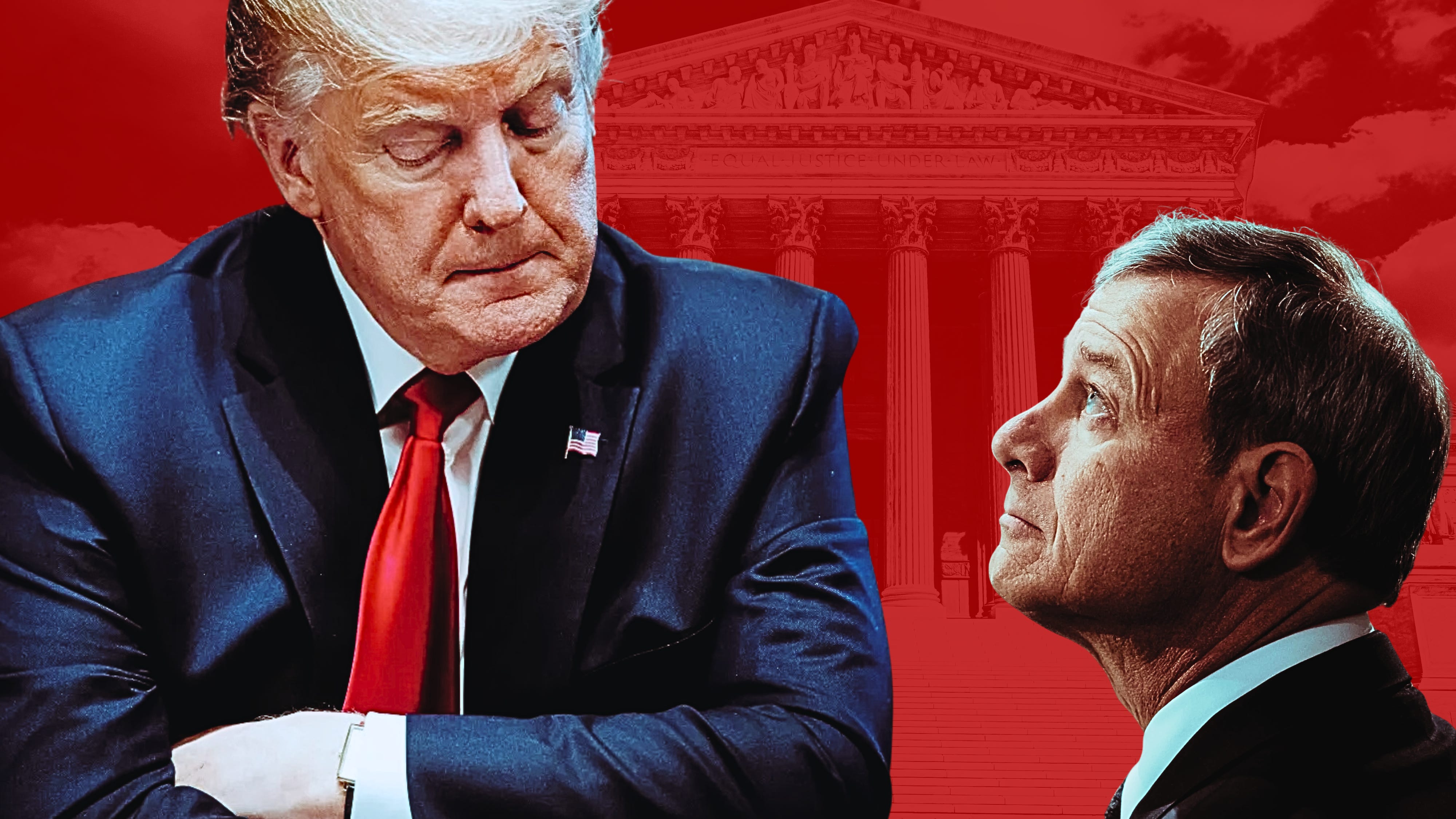
Few people noticed that in the counter-constitutional ruling Chief Justice John Roberts orchestrated 17 months ago giving Donald Trump unprecedented immunity to commit crimes as president, Roberts included language reinforcing the pardon power, which was not at issue in that case. But perhaps Trump noticed what Roberts did for him in trying to clear the field of any potential constraints on the pardon power and its abuse.
Roberts was taking it on himself – with the help of his fellow Republican appointees, half of whom were installed by the 45th president – to effectively pardon Trump for trying to subvert the 2020 election. That ruling paved the way for Trump’s return to power by blocking a federal trial on the crimes he was charged with. Why not use that destructive, partisan edict to muffle other potential challenges to Trump’s invented omnipotence?
That’s exactly what Roberts appeared to do by emphasizing the notion that a president has powers to pardon – and to fire executive branch employees – that are absolutely beyond any checks and balances, except for impeachment.
Did the Framers of the Constitution really mean to allow a president to pardon someone who recently enriched him or to allow pardons based on bribery or similar influences?
Take Trump’s pardon of Changpeng Zhou (CZ), a crypto billionaire who had been fined $50 million – and whose company, Binance, just so happened to have helped the Trump family’s new World Liberty crypto enterprise by facilitating a $2 billion purchase of its “stablecoin.” Surely Trump wiping away CZ’s criminal consequences warrants revisiting the claim that Congress can place no limits on what looks like a kind of reward. Don’t worry: Trump said he had no idea who CZ even is. Trust us, this is not corrupt at all….
Roberts’s opinion in Trump v. United States pumps up the pardon power by trying to reinforce it as limitless. Roberts did so knowing Trump had already used the power in disreputable ways in his first term, starting with his first pardon of Joe Arpaio who literally defied court orders–as if that was not a tell of where things were heading. Trump also pardoned people who committed war crimes, and he even used some of the murderous war criminals he pardoned to raise money for his 2020 re-election campaign. (Last month, as I noted, Roberts attended a screening of Nuremberg where the words of the U.S. prosecutor of Nazi war crimes rang out: “We are able to do away with domestic tyranny … only when we make all men answerable to law.”)
In decreeing Trump immune from criminal prosecution for official acts, Roberts claimed “The President’s authority to pardon, in other words, is ‘conclusive and preclusive,’ ‘disabling the Congress from acting upon the subject,’” citing that language from the case of Youngstown Sheet & Tube Co. v. Sawyer. But Youngstown was not about the pardon power at all. It was about the power of a president to seize steel mills to prevent the disruption of materials to aid the military in the Korean War. And the Court rejected President Harry Truman’s assertion of that power. Youngstown does not mention pardons. Not once. But Roberts chose to borrow language from the ruling to try to cement pardons as being utterly beyond legal review or legislation.
The few prior Supreme Court rulings on pardons are worth re-examining. The Burdick case from 1915 was about whether a person could refuse a presidential pardon. In that case, President Woodrow Wilson was trying to use the pardon power to force an editor to reveal the sources of a story about fraud by denying him the power to assert his Fifth Amendment right not to incriminate himself; the editor refused to testify and was held in contempt. In Burdick, the Court focused only on the “narrow question” of whether a pardon had to be accepted to be effective or enforceable. It ruled that a pardon could be rejected. It did not hold the pardon power to be beyond any legislative rules.
Another case, Ex parte Garland, addressed whether Congress could impose a loyalty oath disbarring attorneys who aided the Confederacy even if they had been pardoned. In that 1867 case, the Court ruled that Congress could not impose that condition on someone President Andrew Johnson had pardoned after the Civil War. That case did include language asserting that the pardon power is “unlimited,” can apply to any federal offense, and is “not subject to legislative control,” but why should that interpretation protecting insurrectionists bind us now in the face of what is unfolding? After all, that Court described the pardon as a president’s “benign prerogative of mercy.”
Why should we be bound by such an interpretation when the pardon power is not being dispensed as a “benign prerogative of mercy” but rather as a malignant act of caprice or worse? If the Roberts Court can claim to find immunity in Article II of the Constitution – where there is none – then why can we not argue that there must be some similarly invisible constraints on pardons being deployed in ways that are deeply destructive of equal justice and common sense, or amount to self-dealing for personal gain or bribery?
The rationale for vesting in the president the power to issue a pardon, rather than Congress, is grounded by the Federalist Papers in the notion that the president would be a person of good character: “As the sense of responsibility is always strongest, in proportion as it is undivided, it may be inferred that a single man would be most ready to attend to the force of those motives which might plead for a mitigation of the rigor of the law, and least apt to yield to considerations which were calculated to shelter a fit object of its vengeance. The reflection that the fate of a fellow-creature depended on his sole fiat, would naturally inspire scrupulousness and caution; the dread of being accused of weakness or connivance, would beget equal circumspection, though of a different kind.”
That does not describe the 47th president at all.
What happens when the “benign power to mitigate against injustice” is wielded to shield from any accountability the former president of Honduras, Juan Orlando Hernandez, who was convicted of flooding the United States with 400 tons of cocaine? Trump issued this pardon the same week it was revealed that his administration murdered two boat crew members who had survived an initial attack off the coast of Venezuela – an action many have called a war crime. Trump and his advisers are claiming an inherent right to summarily execute men not even charged with the drug trafficking crimes Hernandez was convicted of committing, under the guise of a war that Congress has not declared. And it comes as Trump has assailed Members of Congress for standing up against illegal orders to servicemembers, calling for six legislators to be hanged for sedition.
That pardon comes on the heels of Trump pardoning David Gentile, a billionaire who bilked investors in a $1.6 billion scheme and who ruined the financial futures of countless Americans. Now he doesn’t have to pay any of them millions in restitution.
And the list goes on and on of corrupt people Trump has released from prison and back into our communities. That list includes those rightly convicted of violently attacking Capitol Police to help him try to stop Congress from certifying the 2020 election results.
Why should we tolerate Trump’s rampant manipulation and desecration of the law?
Why shouldn’t a bill of impeachment for Trump include his abuses of the pardon power? It should be added to numerous other transgressions of the laws that he is charged with faithfully executing, like how he has blocked money Congress appropriated to fund scientific research and mitigate poverty, instead used our nation’s wealth and power to benefit foreign leaders who kiss up to him, even to the detriment of American families.
Before John Roberts did it for him by inventing broad presidential immunity, Trump audaciously claimed a right to pardon himself. And now he is flouting the Constitution’s term limits for presidents by selling 2028 hats while his close allies float a plainly illegal third term and he raises campaign cash. Meanwhile, Trump has claimed that President Joe Biden’s pardons are invalid if they were signed by autopen, even though a statute expressly recognizes the validity of autopenning, which Trump himself has also used.
Why should we not regard the Roberts Court’s Trump-serving declarations as anything more than the exercises of raw, partisan political power by operatives in black robes?
Reining in the pardon power may seem like a long shot, but why not make the case for reforming it along with everything else that needs reform to help make our democracy actually work for We the People of the 21st century?
We should be questioning the old assumptions, too – thinking broadly and dreaming boldly about what needs to change for our society to thrive, and not just the billionaires backing Trump or currying his favor. To really make America great, we cannot be afraid to call out corruption, including the corruption and mayhem of the pardons under Trump, along with any other prior misuses of that power, so it can never be so abused again.
What I’m Reading:
The transcript of the You Might Be Right podcast “Has Pardon Power Gone Too Far?”
You can also listen to the episode where former Governors Phil Bredesen and Bill Haslam discuss pardons with Steve Vladeck and Mike Nelson, including potential reforms.
The chapter on presidential power in my new book, Without Precedent: How Chief Justice Roberts and His Accomplices Rewrote the Constitution and Dismantled Our Rights.
My publisher, Bold Type Books, is offering a holiday discount of 20% off on my book. I guarantee you will learn something new in every chapter!
And, of course, the Constitution.
Your support fuels COURIER
This holiday season, you can help power courageous journalism that never bows down to MAGA or pre-complies — one t-shirt, mug, bag or sticker at a time.
Shop now to support fearless, factual journalism.
Enter COURIER10 at checkout to get 10% off
Advertise in this newsletter
Do you or your company want to support COURIER’s mission and showcase your products or services to an aligned audience of 190,000+ subscribers at the same time? Contact advertising@couriernewsroom.com for more information.
I still do not understand the legality of the Supreme courts decision on presidential immunity. The statutes seem very clear, in word and intent, and as far as I can see, SCOTUS is not allowed to create or alter existing constitutional law. That is for Congress alone. This was not an interpretive dance, and there was no misleading language in article 2 about immunity for Congress or the President. Can this be rescinded, as this seems to be a clear breach of the fiduciary responsibility of SCOTUS ?
Thank you for this analysis of the abuse of the pardon power. I really appreciate you highlighting that this must only be used by a president with character. Obviously, that is not remotely true today. In fact, it would be laughable if it weren't so horrific.