


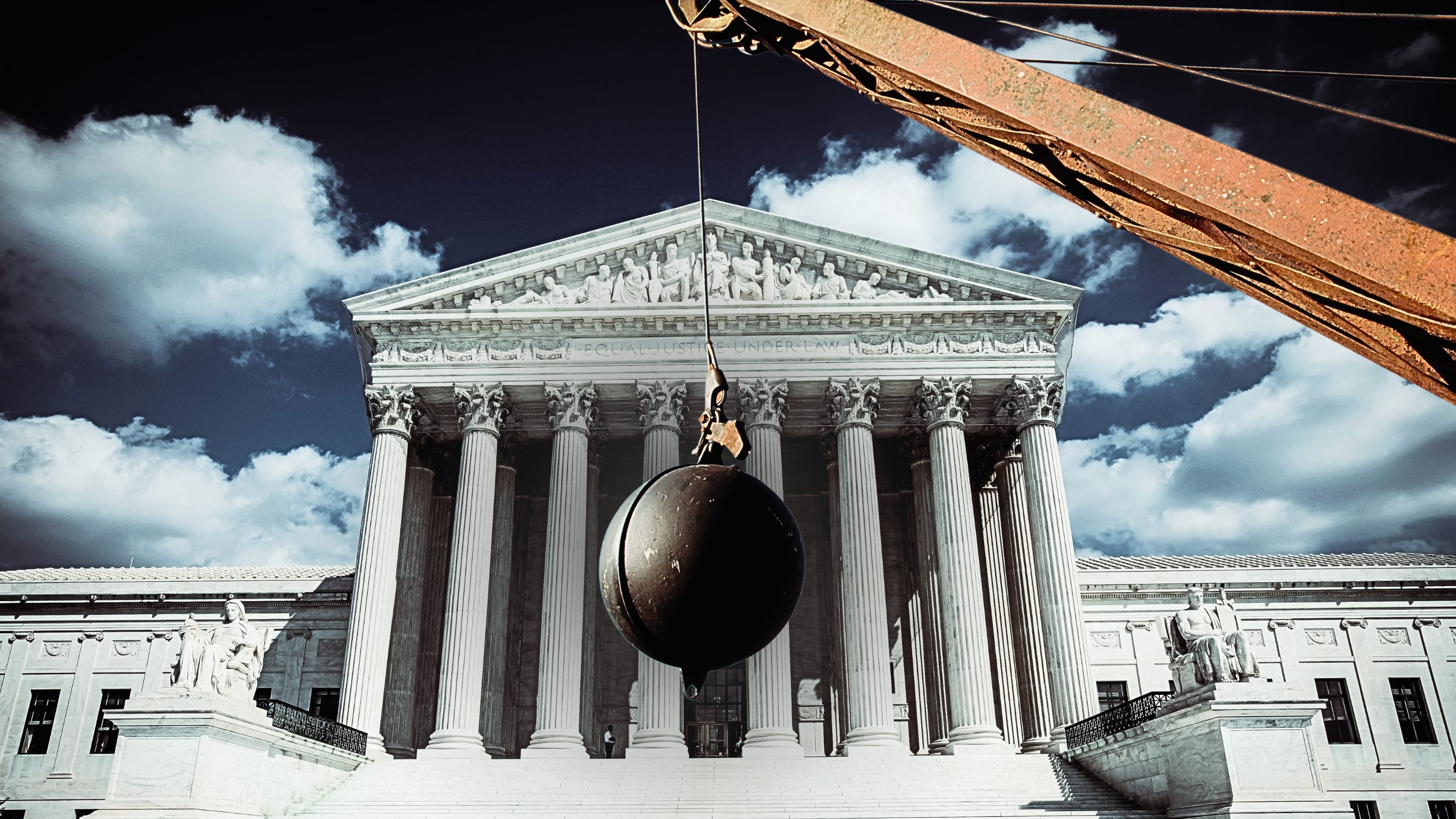
The Roberts Court’s edict in the Callais case is allowing the former Confederacy to re-segregate congressional delegations, a stunning turn of events designed to distort the midterm elections. Its rank partisanship advances Karl Rove’s fever dream of a “permanent Republican majority,” a profoundly illegitimate action by Roberts and his fellow Republican appointees in aid of Donald Trump and his MAGA extremism.
It has been 130 years since the Supreme Court last issued such a destructive edict in favor of racial segregation. That case, Plessy v. Ferguson, immorally ratified racial apartheid in America, despite the 13th, 14th, and 15th amendments birthed from the blood and sacrifice of the Civil War. As President Abraham Lincoln said so eloquently in his Gettysburg Address in 1863, “Our fathers brought forth on this continent, a new nation, conceived in Liberty, and dedicated to the proposition that all men are created equal. Now we are engaged in a great civil war, testing whether that nation, or any nation so conceived and so dedicated, can long endure.”
Plessy broke the promises of the amendments that had led to the election of the first Black U.S. Senator, Hiram Revels, along with more than 2,000 federal, state, and local Black representatives during the 12 years of the Reconstruction–before white supremacists regained national and state power. That decision blessed the flourishing of Jim Crow as the law of the land–and with it an array of obstacles to Black representation–until the Voting Rights Act was finally passed in 1965.
Despite Plessy, there were some real breakthroughs along the way before then.
In 1939, for example, Supreme Court Justice Felix Frankfurter helped block a “grandfather clause” that made it harder for Black Americans to vote, noting that a facially neutral law could still violate those Amendments if its effect was to exclude Black voters. As he put it, and later Supreme Court justices recognized, the Constitution forbids both “sophisticated, as well as simple-minded, modes of discrimination.”
President Harry Truman worked with the NAACP to order the desegregation of the armed forces after so many Black soldiers fought and sacrificed to defend freedoms abroad that they themselves were denied at home by white supremacists.
In 1954, Chief Justice Earl Warren, the former Republican governor of California, penned and secured a unanimous ruling in Brown v. Board of Education, striking down racial segregation in public schools.
But those landmark victories were not enough to secure fundamental rights for Black Americans. Success required sustained mass action and extraordinary bravery.
Reverend Martin Luther King, Jr., beautifully summarized that historic civil rights movement in his acceptance speech for the 1964 Nobel Peace Prize, lifting up “the thousands, faceless, anonymous, relentless young people, black and white,” and extolling:
“Their courageous and disciplined activities have come as a refreshing oasis in a desert sweltering with the heat of injustice. They have taken our whole nation back to those great wells of democracy which were dug deep by the founding fathers in the formulation of the Constitution and the Declaration of Independence.”
The following year, Congress passed the Voting Rights Act of 1965, blocking Southern states from making a change in election rules unless they could prove it “neither has the purpose nor will have the effect of denying or abridging the right to vote on account of race or color.” As President Johnson emphasized when he signed the VRA into law: “The vote is the most powerful instrument ever devised by man for breaking down injustice and destroying the terrible walls which imprison men because they are different from other men.”
But the backlash was swift. Just 15 years later, in Mobile v. Bolden, the man who would become John Roberts’ mentor, Bill Rehnquist, worked with other Republican appointees to assert that violations of Section 2 of the VRA could be proven only by intent, not effect. Justice Thurgood Marshall dissented, warning that this restriction would make the VRA protect “nothing more than the right to cast meaningless ballots.”
The year after that, fellow clerks would note how closely aligned Roberts was with Rehnquist’s hostility toward civil rights. Rehnquist then secured a job for Roberts working directly with Ronald Reagan’s Attorney General, where Roberts spearheaded efforts to block Congress from overturning Mobile. Roberts–who had zero experience with voting rights other than staging for a justice hostile to them–lost that battle, and in 1982 Reagan signed the amended VRA into law.
It took less than 45 years for John Crow–I mean John Roberts–to go from spending hundreds of hours trying (and failing) to stop Congress from protecting Black voters from vote dilution to him handing the pen to Sam Alito, his eager henchman, to drive a dagger through the heart of the VRA and its protections in Section 2 of the law.
A few moves earlier on the dreadful chessboard where Roberts is trying to rig elections to favor the white-dominated political party that put him on the bench, Roberts gutted the pre-clearance rules for the South to change voting rules and maps. Then the Roberts Court blocked federal courts from stopping partisan gerrymandering, under the pretense that the VRA only barred racial gerrymandering. Then, like some hack magician saying presto-chango before pulling a planted rabbit from a hat, Roberts waved his wand to allow racial gerrymandering that diluted the Black vote as long as the white legislature–wink, wink, nod, nod–calls it “partisan,” since the overwhelming majority of Black Americans vote Democratic.
More and more everyday Americans and leaders alike are calling for serious reform of the Supreme Court. Between the illegitimate Callais ruling, the way Roberts invented unprecedented criminal immunity for Trump, the overturning of Roe v. Wade, and the ongoing ethical scandals that have engulfed this neo-Confederate Court, we are witnessing a massive sea change in public consciousness about the Supreme Court.
There is a growing understanding that to restore and expand our rights, we must rip out–at its roots–the anti-democratic notion of judicial supremacy. An unelected high court packed with ringers determined to rollback legal precedents protecting our liberties should not be allowed to have the final say to restrict our rights, like our voting rights.
As Abraham Lincoln warned in his first Inaugural Address: “If the policy of the Government upon vital questions affecting the whole people is to be irrevocably fixed by decisions of the Supreme Court, the instant they are made in ordinary litigation between parties in personal actions the people will have ceased to be their own rulers, having to that extent practically resigned their Government into the hands of that eminent tribunal.”
Until we strip the Roberts Court of the power to restrict our voting rights and to unleash the scourge of billionaire dark money in our elections, we will not be able to secure our freedoms–or our destiny as a thriving democracy grounded on liberty and justice for all.
What I’m (Re)Reading:
The op-ed I wrote with David Daley about John Roberts growing up in a tony all-white enclave steps from the sandy shores of Lake Michigan.
My book, Without Precedent, which details how Roberts got the job at the Justice Department working to blunt the Voting Rights Act and more.
The Constitution’s 15th Amendment, which established the right to vote for Black men who had been freed from slavery and also granted Congress the power to protect that right.
John Roberts is a radical hiding in a robe. Look at the totality of his tenure.
I would never call him a conservative. I would label him a fascist who wants to eliminate our constitution.